Dienstag, 13. März 2012
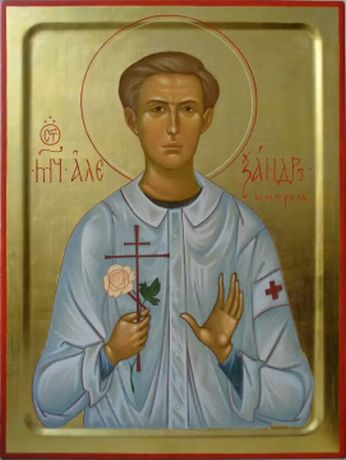
Alexander Schmorell and his small circle of friends were the the first Germans to publicly protest the Holocaust during WWII. News articles covering the "canonizing" of the anti-Nazi activist Alexander Schmorell on domradio.de here:
http://www.domradio.de/aktuell/79629/die-russisch-orthodoxe-kirche-spricht-alexander-schmorell-heilig.html
and in the Mittelbayerische here:
http://www.mittelbayerische.de/nachrichten/oberpfalz-bayern/artikel/widerstandskaempfer_schmorell_/753502/widerstandskaempfer_schmorell_.html
Jim Forest gives us a summary of Schmorell's life in English here:
http://www.jimandnancyforest.com/2011/02/02/alexander-schmorell-a-witness-in-dark-times/
Photos of the canonization service can be seen on Pravmir here:
http://www.pravmir.com/canonization-in-munich-saint-alexander-schmorell/
His organization, the White Rose Society still exists. See here.
Posted by Pintradex 0 comments
Labels: Era of National Socialism, notable German Orthodox Christians, Saints
Donnerstag, 14. Mai 2009
St Walburga, Abbess of Heidenheim
St Walburga was born in Devonshire, England in A.D. 710. Her parents were a West Saxon under-king who became known as St Richard, and St Boniface's sister, Winna. She had two brothers, boys who grew up to be known as SS Willibald and Winibald. When she was eleven, her father and brothers went on pilgrimage to the Holy Land, so she was sent to the abbess of Wimborne who ran her Benedictine abbey with holiness and discipline in mind. Walburga's father died in Lucca a year after her arrival at the abbey, and she remained there for twenty-six years, receiving a good education, including the study of Latin. This last skill allowed her to write the account of her brother Willibald's pilgrimage, an act which has led to her being seen as the first female author of England and Germany.
Boniface wrote to the Abbess, asking that nuns be sent to help in in his work, and in A.D. 748, his wish was granted when the Abbess sent along some Sisters, Walburga amongst them. En route to Germany by boat, a great storm arose. As the waters raged above and beneath, Walburga knelt on the deck and prayed. Instantly, the sea became calm, and the sailors went on to proclaim the miracle at their destination. She made her way through Antwerp and then on to Mainz, where she met her Uncle Boniface and her brother, Willibald.
She spent some time in the abbey at Bischofsheim, and was later made abbess of Heidenheim, part of a double-monastery where her favorite brother, Winibald, ruled over the male monastics. When this beloved brother died, she not only ruled her abbey, but ruled over his monastery as well, and became known for her sanctity and miraculous gifts of healing. The story is told of how one night her Sisters came to accompany her down to supper, and found the hall to her room bathed in a divine light that remained until Matins the next morning.
On September 23, 776, she and her brother, Willibald, went to translate Winibald's relics to Heidenheim, but upon opening his tomb, found that no remains were left. Soon after this miracle, she became ill, and then died on February 25, 777 in the company of Willibald, who laid her to rest near Winibald. Willibald himself died in 786.
Jumping forward about a hundred years to A.D. 870, the Bishop of Eichstadt in Bavaria went to restore Walburga's monastery and church. In the process, the workmen desecrated her tomb, and she appeared to them to reproach them for their negligence. The good Bishop reacted by ensuring a solemn and respectful translation of her relics to the Church of the Holy Cross (now known as St Walburga's) in Eichstadt on September 21. But it is what happened twenty-three years later, in A.D. 893, that helps keep St Walburga in our consciousness. In that year, the successor to the Bishop who translated her relics opened her tomb to retrieve some of those relics for the Abbess of Abbess of Monheim. He found that her remains exuded an oil—a healing substance known as the ‘Oil of Saints’. This precious substance has been exuding from her remains yearly ever since between 12 October and 25 February, her Feast in the Benedictine Breviary, only stopping ‘during a period when Eichstadt was laid under interdict, and when blood was shed in the church by robbers who seriously wounded the bell-ringer’ (from the Catholic Encyclopedia). The Abbess got her relics, and some were also sent to Cologne, Antwerp, Furnes, and other places—many of these translations giving rise to Feasts—but it is her tomb in the church in Eichstadt that, to this day, exudes the fragrant, healing oil. A Benedictine nunnery (see picture below) immediately arose near the church that houses her tomb so that the Sisters could tend to her relics and help with the pilgrims who came for the healing oil. The Sisters have been there now for a thousand years.
Here as well is a brief German account from this site:
Walburga war die Tochter des Königs Richard von England und der Wunna und die Schwester von Willibald von Eichstätt und Wunibald von Heidenheim. Sie wurde um 748 von Bonifatius, dem Bruder ihrer Mutter, mit Lioba und anderen Gefährtinnen als Missionarin nach Deutschland gerufen und lebte als Nonne im Kloster Tauberbischofsheim. Mit drei Ähren habe sie ein Kind vom Hungertod errettet; auf dem Wege zur kranken Tochter eines Burgherrn sei sie von Hunden angefallen worden und habe den ihr zu Hilfe eilenden Knechten zugerufen, sie stehe unter dem Schutz Christi, worauf die Hunde von ihr abließen. 761 wurde Walburga zur Äbtissin des von Wunibald gegründeten Benediktinerklosters in Heidenheim in Franken ernannt; das dortige Doppelkloster war ein wichtiger Missionsstützpunkt. Sie ist dort auch bestattet. Die ‘alpurgisnacht’vom 30. April auf den 1. Mai hat inhaltlich keinen erkennbaren Zusammenhang mit der Heiligen, manche Überlieferungen berichten aber von ihrer Kanonisation durch Papst Hadrian II.er regierte 867 - 872—an einem 1. Mai, und in England wurde ihr Gedenktag am 1. Mai begangen.
Posted by Aaron Taylor 1 comments
Labels: Saints
Mittwoch, 8. April 2009
St Rupert of Salzburg
He was gentle and chaste, simple and prudent, devout in praise of God, full of the Holy Spirit. He was also circumspect in his decisions and righteous in his judgement. He possessed great spiritual discernment, and his good deeds formed his flock into true images of Christ, for he inspired them not only with his words, but by the example of his works. He often kept vigil, weakened himself with fasting, and adorned his works with compassion. He gave away his riches that the poor might not go hungry, believing himself to be one who should clothe the naked and help the destitute.Traditionally believed to have been one of the Merovingians, very little is known about St Rupert’s early life. At some point he was a made Bishop of Worms, a position he held until about 697, when he was invited by Duke Theodo II to Bavaria to do missionary work. St Rupert was greeted by the Duke at Regensberg, and ‘set out immediately on a journey along the Danube, preaching in towns and villages as far as Hungary’ (Butler’s Lives of the Saints, New Full Edition: March, rev. Teresa Rodrigues [Collegeville, MN: Liturgical, 1999], p. 261). He went to Lorch, and built a church dedicated to St Peter on the Wallersee, later becoming the town of Seekirchen.
At St Rupert’s own request, Duke Theodo gave him about two square miles of the old ruined Roman town of Juvavum. According to the previously quoted Life:
Some very reliable men came to the blessed hierarch and told him of an amazing phenomenon which had taken place when they had gone into an unnamed wilderness area now called Bongotobum (Pongau). Three or four times they had seen heavenly lights shining like bright lamps in the sky and they had also experienced a wonderful fragrance in the same place. The pious bishop sent the priest Domingus to Bongotobum because of the reports which he received concerning these lights. It was his desire that the priest would verify the authenticity of these wonders by erecting in that location a wooden cross which the holy one had made and blessed with his own hands. When Domingus arrived, he at once began the First Hour with the monks who had come with him. They saw a bright heavenly light which descended from the sky and lit up the entire region with the brightness of the sun. Domingus saw this vision on three nights in a row, and experienced the wondrous fragrance as well. He erected the blessed cross in that place, and it was miraculously transported to a spot above the dwelling of St Rupert, confirming the truthfulness of what had been reported to him! St Rupert took word of the miraculous occurrence to Theodo and then he himself went into the wilderness to the very spot, and seeing that it was suitable for habitation, began to cut down aged oaks and brought in building materials that he might build a church with dwellings for a monastic community.
Here he built a church and monastery dedicated to St Peter (the Archabbey of St Peter), which St Rupert himself served as abbot, as well as a women’s monastery dedicated to the Theotokos (Nonnberg Abbey), and where he installed his niece, St Erentrude, as abbess. Both are still functioning monasteries under the Benedictine rule, and the latter was made famous as the monastery of Maria von Trapp’s novitiate. St Rupert is said to have encouraged the development of salt mining at his new see, and it is from this industry that the city acquired the name by which it is still known today: Salzburg, or ‘Salt castle’ (I have blogged about this beautiful city a little bit before, in connection with St Rupert’s successor, St Vergilius). For this reason, St Rupert is often depicted holding a container of salt (see here, for instance).
Despite his attachment to a particular see, St Rupert continued to travel throughout the area, ‘preaching the Faith and founding many other churches and monasteries’, until finally, ‘After a life of strenuous activity he left his helpers to carry on the work and returned to Salzburg, certain that he was about to die. He died on Easter Sunday, probably between 710 and 720’ (Butler, p. 262). According to the Catholic Encyclopedia:
. . . [H]e died at Salzburg, aided by the prayers of his brethren in the order; his body reposed in the St Peterskirche until 24 September 774, when his disciple and successor, Abbot-Bishop St Virgil, had a portion of his remains removed to the cathedral. On 24 September 1628, these relics were interred by Archbishop Paris von Ladron (1619-54) under the high altar of the new cathedral. Since then the town and district of Salzburg solemnize the feast of St Rupert, Apostle of Bavaria and Carinthia, on 24 September.
One can read more about St Rupert in German here and here, and about Nonnberg Abbey here. The second link includes the following hymn for Ss Rupert and Vergilius:
Lied zum Fest der Heiligen Rupert und VirgilMelodie: Gotteslob 639 (Ein Haus voll Glorie schauet)Ein Jubellied erschalle,
dem heiligen Bischofspaar,
das hier in unserem Tale
einst Hirt und Lehrer war:
Singet Preis und Lob
Gott, der sie erhob
auf Salzburgs Bischofsthron
und uns zum Schutzpatron.
Sankt Rupert hat verkündet
das Evangelium,
den Bischofssitz gegründet
als Hort dem Christentum.
Gottes Wort und Machtist in dunkler Nachtuns Schirm und unser Lichtbis Christi Tag anbricht.
Sankt Virgil trug die Lehredes Glaubens in die Fern;
dass er das Land bekehre,
war Auftrag ihm vom Herrn.
Hütet Gottes Geist,
der den Weg uns weist,
dem Volk auf Pilgerfahrt,
das um das Kreuz sich schart.
Posted by Aaron Taylor 1 comments
Labels: Saints
Freitag, 20. Februar 2009
St Pirminius in Reichenau
Saint Pirminius, abbot and bishop, is led by the princes Berthold and Nebi to Charles, who entrusts Reichenau to him. He drove out the snakes and during his three-year stay organized monastic life.
The inscription, ora et labora, is a Benedictine exhortation (in Latin) to 'pray and work'. This points to the abbey's monastic roots. Abbot Walahfrid Strabo (842-849), in a letter to Pope Gregory IV (827-844), praises the abbey in these words:
That earlier-named site of our endeavors indeed occupies first place in these regions. It is dedicated to the Most Pure, Blessed Virgin Mary and the Prince of the Apostles Peter. A not insignificant group of men who conduct their lives after the Rule of Saint Benedict is united there. The fullness of their spiritual wisdom nourishes the adjacent land with ample instruction.
Saint Pirminius left Reichenau in 727, and reposed on November 3, 753, as Abbot of Hornbach in the Palatinate, the last monastery that he founded. His holy relics are preserved in the Jesuit Church of Innsbruck.
Visitors to Reichenau should by all means visit the treasure room – and do confirm ahead of time that it will be open – in order to venerate a large relic of the the Holy Apostle and Evangelist Mark, as well as a number of other ancient relics, most of which were likely brought from Constantinople during the Crusades.
Holy Saint Priminius, pray to God for us!
Posted by Aaron Taylor 0 comments
Labels: Saints
Montag, 16. Februar 2009
Hymns for St Anscharius from Sweden & Bremen
Most noble father, Anskar,
Restore us by thy grace,
And those who wander now afar
In Christ's own bosom place.
In holy strife contending
Thou did'st the faith proclaim
To Danes and Swedes declaring
The honour of His name.
An unbelieving nation
From thee the light receives,
The teachings of salvation,
It now with joy believes.
Thou to God's sheep hast given
The food they fain would claim,
And earnestly hast striven
To glorify His name.
To the great King thou bringest
When earthly strife doth cease,
The talents thou receivest,
With manifold increase.
To Father, and His only Son
Be laud and honour given
To Holy Spirit, Three in One
In earth and highest heaven.
Ye men of Bremen sing with joy,
Your hearts with minds and tongues employ,
Such wondrous gifts without alloy
Each with beauty all its own
Of joyful sound the piercing reed
To praise your glorious patron, speed.
Blest Anskar, now from troubles freed
High on his triumphal throne.
He, God's High priest midst Northmen rude
The pattern life to Romans shewed
In Heaven's high fortress unsubdued
Now holds his prize in glory.
Once nurtured up in Corbey's Hall,
His sanctity acclaimed by all,
To highest priesthood hears his call,
Rejoice, and sing his story.
With wide stretched sails, in faith he flies
Displays to wondering Danish eyes
The Lamb of God that rules the skies,
Bids them worship at His Shrine.
In pagan lands hard hearts he breaks,
Disciples for the Mister makes
Thy signs and merits conscience wakes,
Fount of eloquence divine!
The conqueror of kingdoms three,
Temples profane destroyed must be
Vain idol worship fain must flee,
For Christ are won these regions
In faith shine forth the Danes and Swedes
Where Bremen's faithful bishop leads
Icelanders, too, forsake their creeds
Greenlanders and Norwegians.
Oh, mind upraised, to things on high
Oh, salt of earth! oh sanctity!
Oh, light, no bushel hidden by,
Shining now with heavenly beam!
The warrior weeps, with grief cast down
Lest he should lose the martyr's crown,
'Twas surely promised for his own,
Once in brightest vision's gleam.
The Cup of Solomon the True
He drinketh yea, death's tortures too,
Though not by violent sword thrust through
Martyrdom he is denied.
Abuse and threats on every hand,
Tormentors, tyrants, round him stand,
His life a sign to every land
Faith triumphant will abide.
In hope of contemplation sweet
In thickest forest finds retreat
And there pours out oblation meet,
Corn and wine in Jesus name.
For though absorbed in cares of earth
He loves the things of highest worth
Two lives he leads; e’en from his birth
Brightly burns the sacred flame.
To Christ, of all his life the End
Triumphantly his steps do bend,
To Thee my spirit I commend,
Dear Lord’, he breathes, believing
Then to his brethren bids farewell,
Is taken up, in heaven to dwell
With rapture those who loved him well
Can scarce refrain their grieving.
Oh! Anskar blest, to thee we pray
As we revere thy name today,
Be thou our leader that we may
The path of virtue cherish.
Guide ever through the trackless world
Thy pilgrim sheep to the true fold,
Lest wolves upon thy flock take hold
And far from home we perish.
Posted by Aaron Taylor 0 comments
Labels: Saints
Sonntag, 15. Februar 2009
St Anscharius of Hamburg & Bremen, Apostle of the North & Patron of Germany

St Anskar came from a noble family of Amiens, Picardie, in modern France, who may have been close in some capacity to Charlemagne. While still a boy, he received the first of many ‘celestial visits which admonished him to turn away his thoughts from things on earth and to keep his whole heart open to heavenly influences’. According to St Rimbert, the Mother of God appeared to St Anskar, who had previously indulged in childish games with his fellows, saying, ‘If you desire to share our companionship, you must flee from every kind of vanity, and put away childish jests and have regard to the seriousness of life; for we hate everything that is vain and unprofitable, nor can anyone be with us who has delight in such things.’ Apparently, the boy took this to heart, and spent more time in ‘reading and meditation and other useful occupations’, eventually receiving tonsure in the Benedictine monastery of Old Corbie in his native region (Chapt. II).
But it was a second set of experiences that seem definitely to have fixed St Anskar on the path of sanctity. The first was the death of Charlemagne, at which, upon hearing the news, the Saint was ‘affected with fear and horror’. St Rimbert tells us:
Accordingly he put aside all levity and began to languish with a divinely inspired remorse; and, devoting himself wholly to the service of God, he gave attention to prayer, watching and fasting. By these virtuous exercises he became a true athlete, of God, and, as a result of his persistent severity, the world became dead to him and he to the world. (Cf. Gal. 6:14)
When the Day of Pentecost came, the grace of the Holy Spirit, which was at this time poured forth upon the apostles, enlightened and refreshed his mind, so we believe; and the same night he saw in a vision that he was about to encounter sudden death when, in the very act of dying, he summoned to his aid the holy apostle Peter and the blessed John the Baptist.
In the east, where the light rises, was a marvellous brightness, an unapproachable light of unlimited and excessive brilliance, in which was included every splendid colour and everything delightful to the eye. All the ranks of the saints, who stood round rejoicing, derived their happiness therefrom. The brightness was of so great extent that I could see neither beginning nor end thereof. . . . When, then I had been brought by the men whom I mentioned into the presence of this unending light, where the majesty of Almighty God was revealed to me without need for anyone to explain, and when they and I had offered our united adoration, a most sweet voice, the sound of which was more distinct than all other sounds, and which seemed to me to fill the whole world, came forth from the same divine majesty, and addressed me and said, ‘Go and return to Me crowned with martyrdom.’ (Chapt. III)
Apparently, St Anskar served for a time as ‘master of the school dedicated to St Peter’ (Chapt. IV), but in 822 he was sent to the foundation of New Corbie far to the north, in the Sollinger Wald in Westphalia in what is now Germany. It seems his services as a schoolmaster and homiletician were desired there, a fact which St Rimbert emphasises in his concern that St Anskar not be thought to have violated St Benedict’s clear command of stability in RB 58—‘But let him understand that according to the law of the Rule he is no longer free to leave the monastery . . .’ (The Rule of St Benedict in English and Latin, trans. Justin McCann [Fort Collins, CO: Roman Catholic, n.d.], p. 131). (Chapt. VI)
It was at New Corbie that St Anskar came to the attention of King Harald 'Klak' Halfdansson from Denmark, who had been converted to Christianity at the court of Charlemagne’s son and successor, Louis the Pious. Upon returning to Denmark, King Harald took the holy man and his companion, Autbert, with him to build a church and school and to teach his people the new Faith (Chapt. VII). But while St Rimbert tells us that ‘many were converted to the faith by their example and teaching, and the number of those who should be saved in the Lord increased daily’ (Chapt. VIII), St Anskar was soon summoned before Louis again. Having been told not even ‘to stop and shave’ (believed to be a reference to renewing his tonsure, one should note), he arrived to receive the king’s request that he go with an embassy to Sweden to preach the Gospel there. Thus, as Christopher Dawson observes, ‘Christianity first penetrated into Scandinavia through the work of St Anskar’ (Religion and the Rise of Western Culture [Garden City, NY: Image, 1958], p. 85). (Chapt. IX)
appointed him as his legate for the time being amongst all the neighbouring races of the Swedes and Danes, also the Slavs and the other races that inhabited the regions of the north, so that he might share authority with Ebo the Archbishop of Rheims [a co-consecrator of the new bishop], to whom he had before entrusted the same office. (Chapt. XIII)
St Rimbert tells us that his elder faithfully administered his diocese, converting many of the heathen by the example of his life. He also redeemed young boys from slavery to educate them and train them to serve the Church—a good work which has been depicted in the illustration above (Chapt. XV). According to Butler, St Anskar continued to oversee missions in Denmark, Norway, and Sweden (the last being administered by an auxiliary bishop), built churches, and founded a library, giving himself over to this labour for thirteen years. But in 845, Vikings destroyed Hamburg, and the bishop and his flock barely escaped with their lives (Chapt. XVI). Soon after, as the bishop of Bremen had fallen asleep in the Lord, that see was joined with Hamburg into a new archbishopric under the oversight of St Anskar (Chapt. XIII), who continued to foster missions in various parts of the North.
It is interesting to reflect that St Anskar carried out many of his dangerous missions among the Northern heathens with the expectation that he would likely be martyred, in accordance with the commandment he had received from God as a young man (related in Chapt. III). But while the opportunity to shed his blood frequently eluded him, St Rimbert tells us, ‘The life that he lived involved toils which were accompanied by constant bodily suffering: in fact his whole life was like a martyrdom’ (Chapt. XL). At last, in his old age, St Anskar also began to suffer from a final martyrdom—a wasting illness which tormented him slowly over the course of some months. Having arranged for a glorious celebration of the Feast of the Meeting of Our Lord, this holy hierarch fell asleep in the Lord the very next day. Even though he did not meet a violent end, according to St Rimbert (Chapt. XLII), his can still be held to have been a martyr’s death:
For day by day, by tears, watchings, fastings, tormenting of the flesh and mortification of his carnal desires, he offered up a sacrifice to God on the altar of his heart and attained to martyrdom as far as was possible in a time of peace. And inasmuch as the agent, though not the will, was lacking in order to bring about the visible martyrdom of the body, he obtained in will what he could not obtain in fact. We cannot, however altogether deny that he attained actual martyrdom if we compare his great labours with those of the apostle. In journeyings often, in perils of waters, in perils of robbers, in perils from his own race, in perils from the heathen, in perils in the city, in perils in lonely places, in perils in the sea, in perils among false brethren ; in labour and distress, in watchings often, in hunger and thirst, in fastings; often, in cold and nakedness ; besides those things which are without, that which came upon him daily, the care of all the Churches. Who was weak and he was not ? Who, was offended and he did not burn? (Cf. II Cor 11:26-9)
Reader Isaac Lambertson has written a beautiful Service for St Anskar. The first verse of Ode VI of the Canon reads, ‘The rivers and seas of the North were honoured to bear thee on thine apostolic journeys, O Ansgar, disciple of Christ, for the ship of thy soul was propelled by the Holy Spirit.’ Here, in conclusion, is the dismissal hymn of the Saint:
Ever moved by love for God and man, O Ansgar, like the apostles thou didst journey afar to bring salvation to the benighted, offering up thine afflictions upon the altar of thy heart, in thy toils and distress bearing witness unto thy Saviour like a martyr, enduring perils on land and at sea for His sake, undaunted by temptations and tribulations. Wherefore, pray with boldness, that our souls be saved.
Posted by Aaron Taylor 0 comments
Labels: Saints
Donnerstag, 29. Januar 2009
St. Gall (d. 646)

St. Gall was born in Ireland and was sent by his parents to be educated at the famous monastery of Bangor. He was ordained with the name Gall (possibly a Latin form of the gaelic gall, meaning “foreigner”) St. Gall was chosen together with eleven other monks to accompany St. Columban (not to be confused with St. Columba or Columcille of Iona) on a missionary venture to Gaul.
According to the Catholic Encyclopedia (1913), Gall departed for the Continent after his ordination in Ireland. On the other hand, a Russian Orthodox Church Abroad site says “the group traveled first to England and then and then, about the year 585, they crossed the channel.”
It must be pointed out that at this time, there was no England, but rather post-Arthurian British cheifdoms facing the encroachment of newly established Saxon territories. If Gall and his colleagues were in fact on the island at this time, they would have arrived about a decade after the death of St. Gildas (c. 570) and a mere generation after the legendary Battle of Camlann (as described in the Annales Cambriae) and the estimated death of Arthur (c. 542).
In 585, they founded a monastic community in the Vosges Mountains with support and kindness of the local Frankish chieftain. Five years later Columban, together with Gall, founded the famous monastery at Luxeuil, a former spa that had been plundered by the Huns.
After Gall recovered he moved to what is now Saint-Gall further west along Lake of Constance. Gifted in language (which may have been a reason he was chosen as a missionary), he learned the local Alemanni dialect and converted so many pagans he was known as the Apostle of Constance.
Tradition says St. Gall was miraculously informed of the death of St. Columban. A monk was then sent to Italy to and returned with the confirmation of St. Columban's repose. A letter from the Bobbio monks explained that Columban’s dying request was that Gall would inherit his abbot's staff. St. Gall wept abundantly. Not only had he been obedient by not celebrating the Divine Liturgy, but he had refused offers to become bishop. St. Gall then resumed the celebration of the Divine Liturgy. He spent most of his time in his cell, leaving it only to preach the Gospel and to instruct his humble flock.
Tradition also says a bear would visit him and bring wood to feed the fire which Gall and his companions had kindled in the forest. Even today a bear is represented on the town flag of St. Gall as the symbol of the Saint.St. Gall died on the of October 16th, 646 at an old age. He left behind a Christianized Alemanni nation. After his death a small church was erected which developed into the Abbey of St. Gall and the surrounding land developed into the Swiss Canton of St. Gallen.
The only writing of St. Gall that has come down to us is a homily which he delivered when his disciple John became a bishop. St. Gall himself had been proposed for this honor but he again declined, recommending his disciple in his stead. (The text of the homily is found in Canisius' Lectiones Antiquae.)
In the territorial reorganization of the Holy Roman Empire of 1803 all the ecclesiastical estates were secularized, and a part of Swabia was incorporated into the state of Bavaria, forming what is now the Bavarian administrative region of Swabia.
Despite losing precious manuscripts during the Protestant Reformation, the Abbey of St Gall is still one of the most important in Europe. Its library is one of the richest and oldest in the world and is home to one of the most comprehensive collections of early medieval books in German-speaking Europe. A new manuscript digitization initiative is underway and can be viewed online here.
The Feast of St. Gall is celebrated on October 16.
Sources:
http://www.roca.org/OA/63/63f.htm#Saint%20Gall
Elgin Moyer "Who Was Who In Church History" Moody Press, 1974.
Posted by Pintradex 1 comments
Labels: Saints
Dienstag, 20. Januar 2009
St. Boniface, Enlightener of Germany (c. 672)
Feast Day: June 5

Boniface was born in Crediton in 680AD into a Saxon family. He was baptised Wynfrith or Winfrid (from the Saxon words wine - friend and frith - peace).
Wynfrith was educated in a Benedictine monastery in Exeter and taught at a monastery at Nursling in Hampshire. It was here he compiled England's first dictionary of Latin grammar. He was ordained priest at the age of thirty.
Three years later in Rome he was commissioned by Pope Gregory II to be a missionary to Germany. He was given the name Bonifacius, meaning maker of good or good deeds. In accepting the commission from the Roman Patriarch, he was bound to use the Roman, rather than the Celtic Christian formula for baptism and to turn to Rome for guidance. His work took him to Hesse, Friesland and Bavaria.
In 722 he was elevated to bishop- without an established diocese. He was charged to "preach to the heathen east of the Rhine".
Faced with local ambivalence toward Christianity, legend says that in northern Hesse Boniface threatened to cut down the sacred Oak of Geismar dedicated to Thor. Boniface called upon Thor to strike him down if he cut the "holy" tree. When Thor did not strike him down, the people converted. He built a chapel from its wood at the site where today stands the cathedral of Fritzlar. Folklore says this was the origin of the Christmas tree. The symbolic felling of Thor's Oak is commonly regarded as the beginning of German Christianization north and east of the old borders of the Roman Empire. Willibald, a contemporary, wrote:
Many of the people of Hesse were converted [by Boniface] to the Catholic faith and confirmed by the grace of the spirit: and they received the laying on of hands. But some there were, not yet strong of soul, who refused to accept wholly the teachings of the true faith. Some men sacrificed secretly, some even openly, to trees and springs. Some secretly practiced divining, soothsaying, and incantations, and some openly. But others, who were of sounder mind, cast aside all heathen profanation and did none of these things, and it was with the advice and consent of these men that Boniface sought to fell a tree of great size, at Geismar, and called, in the ancient... of the region, the oak of Thor.
The destruction of local pagan shrines was a habit that would come back to haunt Boniface.
In 723 he was taken under the protection of the Frankish king, Charles Martel. His mission continued in Hesse and Thuringia where he established convents (Klosteren) and developed a well-oragnized system of churches. This was the foundation on which the Roman Church grew in later years throughout Germany.
Boniface was a prolific writer. He made frequent request to Saxons in England for supplies, money, books, and monks to help him in preaching and teaching. He also sought and gave advice to other clerics in his home country. Many of his letters can be found, translated, at the Medieval Sourcebook website.
Charles Martel and his sons proved to be important patrons of the Church and assisted in etablishing churches and monasteries. Boniface wrote to his old friend, Daniel of Winchester, that without the protection of Charles Martel he could "neither administer his church, defend his clergy, nor prevent idolatry."
In 732 Boniface was consecrated archbishop by Pope Gregory III and subsequently found monasteries and episcopal sees throughout Bavaria, Thuringia, Hesse, and Franconia. In 745 Boniface was elevated to Primate of all Germany by Pope Zachary and was given Mainz as his cathedral. In the period 742-747, Boniface directed a series of reforming councils in Francia that dealt largely with abuses by new and inexperienced clergy.

Charles Martel's oldest son, Carloman, left public life in order to live as a monastic, leaving the entire Frankish kingdom to his younger brother, Pippin the Short. A powerful precedent was set that would forever change the political and religious dynamics in Europe; in 752 Pippin was anointed king by Boniface, the first-known instance in the West of such a ceremony.
He had never relinquished his hope of converting the Frisians, and in 754 he set out with a small retinue for Frisia. He summoned a general meeting for the confirmation of converts not far from Dokkum, Netherlands. Instead of his converts, however, a group of armed inhabitants appeared who slew the aged archbishop. According to their own law (The Lex Frisionum), the Frisians had the right to kill him, since he had destroyed their shrines. His body was taken to Utrecht, then Fulda, where his relics still rest today.
A photo of a relic can be seen here. It rests alongside a bone-fragmentfrom Saint Benedict of Nursia.
Boniface made a significant impact on English and European history. In addition to his long guidance of the early church in Germany, he established the structures which allowed it to co-exist with monarchy. He is the patron saint of both Germany and Holland.
Wikipedia states Saint Boniface's feast day is celebrated on June 5 in the Roman Catholic Church, the Lutheran Church, and the Anglican Communion and on December 19 in the Eastern Orthodox Church. The Preface for the Liturgy of St. Boniface's Day in Old English liturgical books reads:
"It is truly meet and just, right and availing to salvation, that we should always and in all places give thanks to Thee, O Holy Lord, Father almighty, everlasting God, Whose grace chose blessed Boniface to the episcopate, Whose teaching made him wise in preaching, Whose power strengthened him to persevere, that by way of the priestly mitre he might reach the palm of martyrdom, both teaching his subjects by preaching, and instructing them how to live by his example, and confirming them by suffering, that he might come to Thee to be crowned, who had fearlessly overcome the threats of his persecutors.
By his intercession, we beseech Thee, may he cleanse us of our misdeeds who pleased Thee with such choice manifestations of Thy gifts, through Christ our Lord. By Whom Angels praise Thy majesty, Dominions worship, the Powers tremble. The heavens, and the heavenly Virtues, and the blessed Seraphim, concelebrate in one exultation, with whom command our voices also to have entrance, we beseech Thee, humbly confessing Thee, and saying: Holy, Holy, Holy," etc. (from the Old Sarum Rite Missal, 1998 St. Hilarion Press)

St. Boniface Church, Chicago, USA, was established by German immigrants in 1865, with the current building dating from 1903. The church, although of significant architectural interest, fell into disuse in 1990 and its future is in doubt.
Sources:
http://www.orthodox.net/western-saints/bede-of-jarrow.html
http://orthodoxwiki.org/Boniface
http://www.allmercifulsavior.com/icons/Icons-Boniface-Apostle.htm
http://www.creditonparishchurch.org.uk/StBoniface.html
http://seabringer.blogspot.com/2006/09/abandoned-st-boniface-church-chicago.html
Posted by Pintradex 1 comments
Labels: Saints
Donnerstag, 15. Januar 2009
Colomanskirche, Schwangau, Bavaria
This church is dedicated to St Coloman of Stockerau, and is located in the village of Schwangau in southern Bavaria near the Austrian border, 1.5 km from the famous Neuschwanstein Castle of Ludwig II of Bavaria. St Coloman was an 11th-c. Irish monk who embarked upon a pilgrimage to the Holy Land. He was accused of being a spy at Stockerau, near Vienna, and being unable to speak German in order to clear his name, he was tortured and hanged. His body is said to have been incorrupt, hanging on the gallows, for a year and a half, and the scaffolding to have taken root and blossomed. Three years after his death, St Coloman’s relics were taken to the Benedictine Abbey of Melk on the Danube (the home of Adso in The Name of the Rose!), in what is now Austria.
Posted by Aaron Taylor 2 comments
Labels: church buildings, Saints
Dienstag, 13. Januar 2009
St. Wolfgang of Regensburg
Saint Wolfgang or Saint Wolfgang of Regensburg (c. 934 - October 31, 994) was bishop of Regensburg in Bavaria from Christmas 972 until his death.
Wolfgang was descended from an aristochratic Swabian famliy and was provided a private education at his home.
Like many European clergy, a full appreciation of Wolfgang's life requires some knowledge of European history and politics. Although such a historical survey is beyond the scope of this blog, it is important to know that Wolfgang was a key figure in Europe's slow march out of what many consider the Dark Ages.
Wars with the Magyars (Huns) resulted in their settlement in roughly what is now Hungary (955). The conversion of the Magyars to Christianity was seen as an important step in reducing their threat to the germanic Holy Roman Empire. Ulrich, Bishop of Augsburg and Emperor Otto the Great sent Wolfgang to the Magyars in order to evangelize them.
He was summoned back in 956 by his friend Henry, Archbishop of Trier, and was appointed as a teacher in the cathedral school of Trier. His residence at Trier greatly influenced his monastic and ascetic tendencies. After Henry's death in 964, Wolfgang entered the Benedictine order in the Abbey of Maria Einsiedeln, Switzerland. He was ordained priest in 968 by Ulrich, Bishop of Augsburg.
Four years later Wolfgang was appointed Bishop of Regensburg by the emperor on September 23, 972. His new duties included the private education of Emperor Saint Henry II; Poppe, future Archbishop of Trier; and Tagino, future Archbishop of Magdeburg.
St. Wolfgang's attempts at Church reform were met with resistance. Yet he is remembered for strengthening and promoting monastic communities in the Ratisbon area. He founded the convent of St. Paul, Mittelmunster (983) and brought various reforms to the Abbey of St. Emmeram (975), the convents of Obermünster and Niedermünster (also at Regensburg), and the Benedictine Abbey of Altach. He took part in the various imperial synods, sometimes accompanying Emperor Otto. The emperor eventually reduced the size of Wolfgang's diocese to make room for a new bishop.
It may have been the ongoing political machinations that disenchanted Wolfgang and drove him to a solitary life as a hermit. Legend says that after having selected a solitary spot in the wilderness, he prayed and then threw his axe into the thicket; the spot on which the axe fell he regarded as the place where God intended he should build his cell. This axe is still shown in the little market town of St. Wolfgang which sprang up on the spot of the old cell.
While traveling on the Danube, he fell ill and was carried to his native Pupping where he died in the chapel of Saint Othmar. His body was interned in Regensburg. He was canonized as a Saint in 1052.
The oldest and best manuscript of Wolfgang's "Life" is in the library of his home Abbey of Maria Einsiedeln in Switzerland. He is often depicted in art with an axe in his right hand, or as a hermit in the wilderness being discovered by a hunter.
Wolfgang's feastday is celebrated on October 31st.
This post incorporates information from Wikipedia and New Advent Catholic Encyclopedia
Posted by Pintradex 2 comments
Labels: Saints