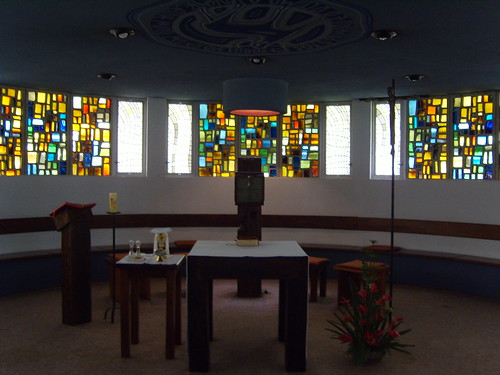
After reading Fr John Meyendorff’s article on the Orthodox Church in
Funk & Wagnall’s Encyclopedia, the very first thing that I read about Orthodoxy was Photios Kontoglou’s hard-hitting, but, I felt, persuasive apologia for traditional Byzantine iconography, ‘The Hopelessness of Death in Western Religious Art and the Peace-Bestowing and Profoundly Hopeful Orthodox Iconography’ (printed in English, in, I believe,
The True Vine—my own copy is buried in a box somewhere in my house). I very quickly wrote off Western religious art. If it wasn’t the fleshy naturalism of the Renaissance and Baroque eras (made for churches like
this), it was the tacky, quickly dated, and hopelessly subjective modernism of the post-Vatican II years (made for churches like
this). Neither one seemed right to me.
But then I was surprised to make a discovery. It was about two and a half years ago, when I was first looking into the history of the
St Benedict medal. I learned somewhere (most likely
here) that the medal as it’s typically produced now had been designed in something called ‘the Beuronese style of sacred art’, at the (I found
here) ‘St Martin's Archabbey, Beuron, Germany’. Now, this name, ‘
Beuron’, was familiar to me. In his wonderful conversion-to-Orthodoxy story,
Fr Placide (Deseille) made a passing reference to this place, saying of his aunts that ‘the great abbeys of Beuron,
Maredsous, and
Solemnes were the high places of their Christianity’ (Archimandrite Placide [Deseille], ‘Stages of a Pilgrimage’,
The Living Witness of the Holy Mountain: Contemporary Voices from Mt Athos, trans. and ed. Hieromonk Alexander [Golitzin] [South Canaan, PA: St Tikhon’s Seminary, 1999], p. 63). It was precisely this passage that sprang to mind when I came across that reference to the design of the medal. It sparked my curiosity as much as the expression ‘the great abbeys’ had fired my imagination.
The story I discovered is a long one, and I haven’t been able to work out all of the precise details. What I do know, is that the main figures in the development of Beuronese art were a group of German artists named Peter Lenz (1832-1928), Jakob Würger (1829-92), and Fridolin Steiner (1849-1906). The three young men went to Rome to work with some members of what had been the ‘Nazarene’ movement, a brotherhood of German artists devoted to St Luke the Evangelist (the first iconographer, according to tradition) who had lived a semi-monastic existence painting religious and neomediæval subjects in a simple, serene style. One critic in 1820 ascribed to the Nazarenes’ work the qualities of ‘simplicity, holiness, and purity’ (Fr Kenneth Novak, ‘The Art of Beuron’,
Angelus Online). George Eliot referred to the Nazarenes as ‘the chief renovators of Christian art, . . . who had not only revived but expanded that grant conception of supreme events as mysteries at which the successive agess were spectators, and in relation to which the great souls of all periods became as it were contemporaries’ (George Eliot,
Middlemarch I, Vol. VI in
Works of George Eliot [NY: The Century, 1910], p. 310). James D. Merritt notes the Nazarenes’ influence upon and anticipation of the
Pre-Raphaelite Brotherhood in England (Introduction,
The Pre-Raphaelite Poem [NY: Dutton, 1966], pp. 9-10). A meeting with one of the Nazarenes, Peter von Cornelius, had a tremendous influence on the art of Ford Maddox Brown (1821-93), who subsequently was a mentor to Dante Gabriel Rossetti and a contributor to the Pre-Raphaelite periodical,
The Germ (in a letter to Maddox Brown, Rossetti apparently writes ‘that if he ever does anything on his own account, it will be under the influence of such inspiration’—Joseph Knight,
Life of Dante Gabriel Rossetti [London: Walter Scott, 1887], p. 22).
So, to return to Lenz, Würger, and Steiner, they were highly influenced by the Nazarene movement. But, in addition, they became fascinated with the ancient Egyptian art that had poured into Europe in the wake of Napoleon’s
Egyptian campaign. According to Novak:
Lenz [the primary theorist among them] thought sacred art should reflect the natural laws of aesthetics through formulae he believed were forgotten after the Greeks and Egyptians. Geometrical proportions determine ideal forms, and the result is an innate harmony comparable to the mathematical relationships in musical composition.
Believing a monastic brotherhood to be the ideal context in which to put their ideas into practice, the three talked about forming a monastery. But in 1868 they met
Fr Maurus Wolter, abbot of the new Benedictine monastery of Beuron. Wolter had initiated a close relationship with the centre of the Gregorian chant revival, Solemnes, corresponding with the abbot,
Dom Prosper Guéranger, and even going so far as to model Beuron on the Solemnes Congregation. The cultivation of traditional Gregorian chant at Beuron dovetailed nicely with the approach to the visual and plastic arts of Lenz, Würger, and Steiner. The three were tonsured as monks of Beuron, taking the names Desiderius, Gabriel, and Lukas. They began an art school at Beuron that—besides designing the St Benedict medal—built churches, painted murals, created mosaics, and even hand-crafted church furnishings and altar vessels in Europe and later in America, based on the principles developed by Desiderius Lenz. Novak lists a few of these (apparently taken from Lenz’s
writings):
The art speaks to the mind of the viewer. The art is itself worshipful and invites the viewer to worship. It does not stand out boldly of itself but is part of an environment of worship.
Works are anonymous, done by group effort, and not for the glory of the artist, but of God.
As in icons, the Beuronese style favors imitation over originality, with freehand copying revealing an artist's true genius.
There is full integration of art and architecture. Painting and sculpture are not ‘stick-ons’ to an architectural plan but an integral part of it. Beuronese art encompasses painting, architecture, altar vessels, and furnishings.
One can see some examples of these principles in practice at the Archabbey of Beuron itself
here, in the crypt of the monastery church at Monte Cassino
here, at the Mauruskapelle
here, in the
Basilica at Conception Abbey in Missouri, at the Abbey of St Hildegard
here, at Maria Laach Abbey in Germany
here, and at the chapel of the Gymnázia Teplice in the Czech Republic
here. There is a beautiful photo of a Beuronese chapel at Daniel Mitsui’s blog
here, and a few images at ‘History and Sources’
here. The photo above is of the 'Great Hall' at St John's University in Collegeville, MN, which was
apparently restored some years ago.