Posts mit dem Label notable German Orthodox Christians werden angezeigt. Alle Posts anzeigen

Dienstag, 13. März 2012

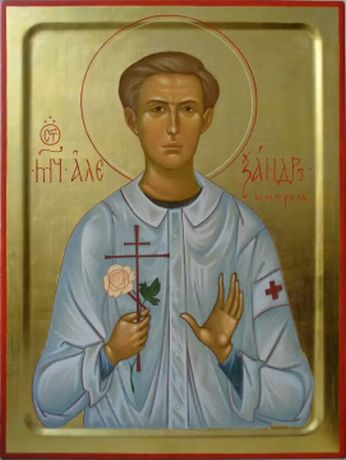
Alexander Schmorell: Orthodoxer Neumärtyrer

Alexander Schmorell and his small circle of friends were the the first Germans to publicly protest the Holocaust during WWII. News articles covering the "canonizing" of the anti-Nazi activist Alexander Schmorell on domradio.de here:
http://www.domradio.de/aktuell/79629/die-russisch-orthodoxe-kirche-spricht-alexander-schmorell-heilig.html

and in the Mittelbayerische here:
http://www.mittelbayerische.de/nachrichten/oberpfalz-bayern/artikel/widerstandskaempfer_schmorell_/753502/widerstandskaempfer_schmorell_.html

Jim Forest gives us a summary of Schmorell's life in English here:
http://www.jimandnancyforest.com/2011/02/02/alexander-schmorell-a-witness-in-dark-times/

Photos of the canonization service can be seen on Pravmir here:
http://www.pravmir.com/canonization-in-munich-saint-alexander-schmorell/

His organization, the White Rose Society still exists. See here.

Dienstag, 16. November 2010

der Kommission der Orthodoxen Kirche in Deutschland
The first session of the Orthodox Episcopal Conference took place on 13-14 November in Essen, North Rhine-Westphalia. It is the new name of KOKID (der Kommission der Orthodoxen Kirche in Deutschland). The Sunday liturgy was concelebrated by five Metropolitans and four Bishops. (Thank you to Ancient Christian Defender. Text taken from orthodoxchristianity.net forums).

Sonntag, 10. Mai 2009

The Letters of Fr Clement (Sederholm)

Ручьёв at Incendiary has thankfully begun the task of translating the letters of Fr Clement (Sederholm), the German-Russian who converted to Orthodoxy from Lutheranism and became a monk of Optina Pustyn'. The first translation was just posted, along with the promise of more.
[Following the request of Christopher at Orrologion, I have begun translating some selections from the letters of Fr Clement Sederholm (1830-1878) to his father. In the book I have acquired there are only 15 letters, and they are mostly from the period of Fr. Clement’s life after he was tonsured a monk at Optina in 1863 (ten years after converting to Orthodoxy). One feature that runs throughout all these letters is Fr Clement's unwillingness to openly argue with his father over points of theology. (Evidently at some point they did have such arguments as they are hinted at in early letters.) While in many letters Fr Clement talks about theological matters it is usually simply stating what the Orthodox believe or do, as in this first selection.]

I can briefly explain to you concerning prolonged prayers in our [Orthodox] Church. Every one of us prays not for himself only and not in their own way. We gather together for common church prayer in order to fulfill the unity and mutual love which is commanded by the Holy Spirit as well as what is prescribed by the apostle: forsake not the assembly as do some (Heb. 10:25). No matter how elevated the apostles stood they did not remove themselves from the assembly of believers (Acts 3:1). And that a few prayers of the Church are stronger than the prayers of one man can be seen from the fact that the Apostle Peter was freed from prison by the prayers of the Church (Acts 12:5-19). Our church prayers are made up of psalms, church songs, and various prayers. Every person praying follows the church prayers as they can: if his thoughts scatter he can quickly gather his senses and again follow after the course of the service and pray. But when someone prays alone and composes prayers himself then if his thoughts scatter it is harder for him for begin again to pray; and where does he start? If you, at your age and after long years of studying lofty subjects, feel how hard it is to keep your thoughts together, what can be said about a beginner? Concerning those who already reached the a high level of spiritual life, they add their short prayers to the common church prayer.

I heartily wish that my explanation turns out to be satisfactory to you.

October 26, 1863

Donnerstag, 9. April 2009

Orthodox German: Hieromonk Clement (Sederholm)


Thanks to Ручьёв of the Incendiary blog, I have found a book I have long been looking for. Of course, it's in Russian - which I don't read - but I at least know that the book has been published in this century rather than the turn of the last (like, 1902).

Православный немец. Иеромонах Климент (Зедергольм) [Orthodox German: Hieromonk Clement (Sederholm)] was published in 2005 by Московское подворье Свято-Введенской Оптиной Пустыни [the Moscow dependency of the Holy-Entry Optina Hermitage].

It contains letters to his father (a Lutheran pastor, thus my interest), two biographies of Fr. Clement (one of which was written by Konstantin Leontiev and is available online here and here [also, John Hogg has begun an English translation of it in the combox here]) and six other articles of his. Two works of his have appeared in English - Elder Leonid of Optina and Elder Anthony of Optina - both published by St. Herman Press.

I am eager to see this text translated into English and would be thankful for any help at all in even a rough translation into English.

I shall also append Leonard Stanton's brief overview of Fr Clement's life in his wonderful book, The Optina Pustyn Monastery in the Russian Literary Imagination (NY: Peter Lang, 1995), p. 152:

The author [of the Life of Elder Leonid of Optina], Karl (later Father Kliment) Zedergol'm, died in 1878, before Dostoevsky's last visit to Optina. Zedergol'm was a cantakerous man of great culture and learning. He was at home both in a monastic setting and in the inner circles of Russia's literary beau monde. He graduated in classics from Moscow University in 1853, having written a master's thesis on Cato the Elder that [Konstantin] Leont'ev, his biographer, called both stimulating and controversial. In the same year, Zedergol'm converted from Lutheranism to Orthodoxy. (His father was the head Lutheran pastor in Moscow at the time.) Zedergol'm was at home in the brilliant Moscow salons, particularly Mrs Elagin's with its erudite ferment of German Romantic thought and Slavophilism. He was a protégé of Ivan Vasil'evich Kireevskii, Russia's first original philosopher, and counted among the friends of his youth some of the leading lights of the Moscow literary intelligentsia, including Tertii Filippov and the 'young editors' of The Muscovite. After a brief career as a layman working in the Holy Synod, Zedergol'm entered Optina Pustyn in 1862 and soon became a monk and a priest as well. He was never himself an elder, nor was he possessed of a sufficiently irenic disposition ever to have been considered for elderhood. He devoted himself to literary endeavors at Optina, as a translator of spiritual works from Latin and Greek into Russian, as the author of the elders' biographies, and as secretary to Elder Amvrosii.